Poetry and prose
Anne of AvonleaPoetry and prose describes the contrast between a factual, practical reading of events and an imaginative vision that reveals their emotional beauty. In the closing movement of the story, Anne Shirley sees romance in Miss Lavendar Lewis and Stephen Irving’s reunion, while Marilla Cuthbert reduces it to a chain of ordinary circumstances. Their disagreement is not resolved by proving one account false: instead, Marilla recognizes the value of Anne’s way of seeing, and Anne’s own poetic interpretation prepares her to notice love in a quieter, more familiar form.
Two Ways of Reading the Same Story
The distinction becomes explicit when Anne explains that Miss Lavendar’s history seems romantic because Anne herself helped bring its participants together. A wrong turn on the way to Mr. Kimball’s led her to Miss Lavendar; meeting her led Anne to take Paul Irving to Echo Lodge. Paul then wrote to his father about visiting Miss Lavendar just as Stephen Irving was preparing to leave for San Francisco. On receiving the letter, Stephen changed his plans and came to Avonlea instead. Anne sees her part in this sequence as a possible instrument of predestination: even if events were bound to happen, she finds meaning in having helped them happen.
Marilla tells the same history without that pattern of providential connection. Years earlier, two young people quarrelled and became sulky; Stephen left for the States, later married, and was happy, while Miss Lavendar remained single. After his wife died, he returned and discovered that his first love had not married after all. In this account, the reunion follows from separations, choices, and changed circumstances rather than from a romantic design. Marilla’s blunt explanation punctures Anne’s excitement, and Anne briefly concedes that the story looks different when rendered as prose.
Yet the contrast is not simply between truth and illusion. Marilla’s version supplies the practical chronology, including the quarrel and Stephen’s intervening marriage, while Anne’s adds attention to coincidence, feeling, and the possibility of providence. The same events sustain both readings. The disagreement concerns what those events mean and which connections deserve to be made visible.
The Reunion as a Test Case
The months of preparation make the difference between these outlooks part of daily life. While Anne’s own modest preparations for Redmond College remain secondary, she spends much of her time at Echo Lodge as Miss Lavendar prepares to marry. Consultations and planning fill the stone house; Anne and Diana Barry visit repeatedly, and Anne even lies awake wondering whether she advised the right colors and style for Miss Lavendar’s traveling dress. The approaching marriage is not an abstract romantic episode for Anne: it has become a shared undertaking, occupying her thoughts and practical attention.
The wedding plan gives Anne’s interpretation a specific place and history. Miss Lavendar and Stephen are to marry on the last Wednesday in August beneath the honeysuckle trellis in the garden, where Stephen proposed to her twenty-five years earlier. Their small gathering is to include Mrs. Irving, Paul, Gilbert Blythe, Diana, Anne, and Miss Lavendar’s cousins. They will leave on the six o’clock train for a trip to the Pacific coast. When they return in the fall, Paul and Charlotta the Fourth will go with them to Boston. Echo Lodge will be closed for the winter, but kept as a summer home: its hens and cow will be sold and its windows boarded, not the house abandoned to strangers. These arrangements give romance a material setting and a future, rather than leaving it only in Anne’s imagination.
Marilla’s response changes after she sees how deeply the story matters to Anne. She stops her sarcastic comments and recognizes that Anne possesses a gift for viewing life through a transforming medium, one that can reveal a glory invisible to people who see only through prose. The scene does not require Marilla to adopt Anne’s account of predestination. Its shift is subtler: practical judgment need not deny the worth of imaginative perception.
From Others’ Romance to Anne’s Recognition
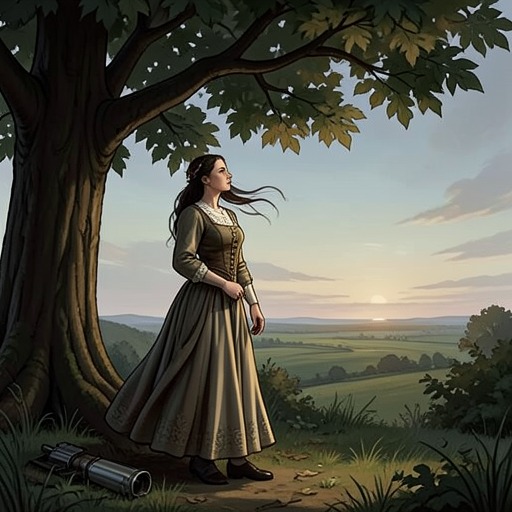
After the preparations and celebration, Anne remains in the quiet rooms at Green Gables, clearing away decorations, washing dishes, and packing the uneaten delicacies for Charlotta the Fourth’s young brothers. Once Charlotta has gone, Anne closes the blinds, locks the door, and sits beneath the silver poplar waiting for Gilbert. Her thoughts are still with Miss Lavendar and Stephen, whose return to each other after years of separation and misunderstanding she calls beautiful.
Gilbert answers by imagining a different kind of beauty: a life shared without separation or misunderstanding. His remark turns the discussion away from a reunion made poignant by lost time and toward the possibility of a love that has grown beside Anne all along. For a moment Anne’s heart flutters, her eyes falter under Gilbert’s gaze, and she blushes. The narrator presents this response as a lifting of a veil: Anne glimpses feelings and realities that she had not recognized before.
That recognition revises, rather than discards, the distinction between poetry and prose. Anne has expected romance to arrive conspicuously, like a gallant figure in a story. Instead, the feeling becomes visible through a quiet exchange with an old friend. What had seemed ordinary friendship is suddenly illuminated as something with its own rhythm and promise. The image of a rose unfolding from its green sheath makes the change one of emergence: the feeling is not imposed from outside but becomes legible when Anne sees what was already there.
Meaning and Narrative Function
The expression links two love stories while distinguishing their shapes. Miss Lavendar and Stephen’s marriage is made moving by a remembered proposal, a long separation, misunderstanding, and eventual reunion. Anne’s response to Gilbert suggests another possibility: romance may be discovered within companionship, not only in dramatic reversals or a return after many years. Gilbert’s brief question prompts the change, but he says nothing more; Anne’s blush is the evidence of recognition, and the story leaves its full development ahead.
The ending also gives the contrast a measured, rather than absolute, conclusion. Anne’s poetic vision does not erase the practical circumstances Marilla describes, and Marilla’s prose does not exhaust the emotional significance Anne finds in them. The two modes reveal different aspects of a shared reality. Through the reunion at Echo Lodge and Anne’s private awakening at Green Gables, the idea becomes both a way of interpreting other people’s histories and a turning point in Anne’s own: love may be beautiful not only when life restores what was lost, but when a familiar friendship is newly understood.